Ajouter à son agenda
 Thibaut Pollet
Soutenance de thèse
Semiconductor quantum dots embedded in micropillar cavities are bright and deterministic emitters of indistinguishable single photons. Scaling up quantum photonic technologies requires interfering photons emitted from independent sources, which in turn demands perfectly identical emitters. Achieving such reproducibility relies on precise cavity fabrication, robust tuning mechanisms, and environmental noise mitigation.
In this thesis, we address all three of these challenges. We first adjust the micropillar cavity diameters individually and narrow the acceptable spectral range of the QD transitions to fabricate sources with nearly identical optical properties. Secondly, we study the noise affecting our single-photon source and find lower QD density across the grown wafers can reduce the charge noise. Finally, making use of our p-i-n diode structure and a fiber on top of the source, we implement both electrical and strain tuning on the emitters.
We demonstrate state-of-the-art two-photon interference of 88% between remote cavity-embedded QDs. This value is in close agreement with the estimated upper bound of 88.3(1)% , calculated by considering only the individual source Hong–Ou–Mandel interference visibilities and the difference in decay rates between the QDs, demonstrating the near-perfect stability of our emitters. These results mark a critical milestone for the development of multi-source quantum devices and pave the way toward the implementation of scalable quantum networks and photonic quantum computers.
Jury members :
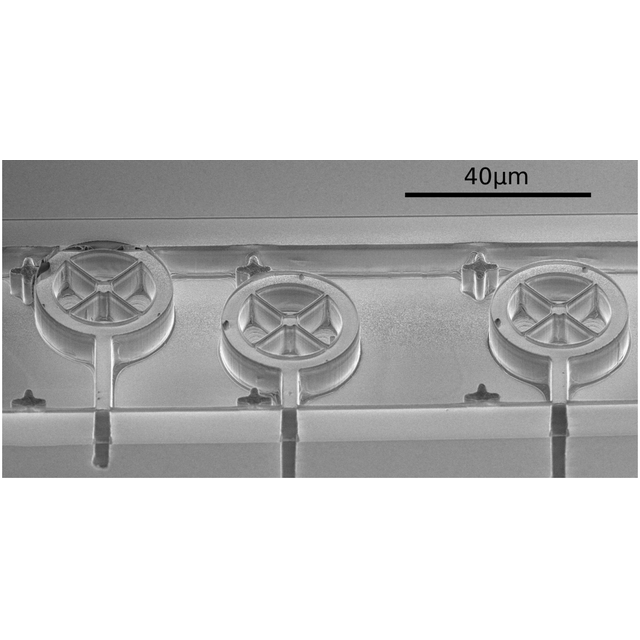
Figure : Scanning electron microscope image of three micropillar single-photon sources.
Amphithéâtre
Centre de nanosciences et de nanotechnologies
10 boulevard Thomas Gobert
91120 Palaiseau