Ajouter à son agenda
 Loukas Kokkinos
Soutenance de thèse
Spin torque nano-oscillators (STNOs) consist of a stacking of a pinned ferromagnetic layer, called polarizer, a non-magnetic spacer layer and a ferromagnetic free layer which can exhibit dynamics when a current passes through the stacking. These STNOs exhibit properties, such as wide frequency tunability, that could be useful for technological applications in telecommunications and RF detection, as well as complex dynamical regimes showing promise for unconventional computing and artificial neural networks.
This thesis explores such complex dynamics in oscillators comprising a magnetic vortex in the free layer (STVOs) via micromagnetic simulations. The results can be divided in three parts.
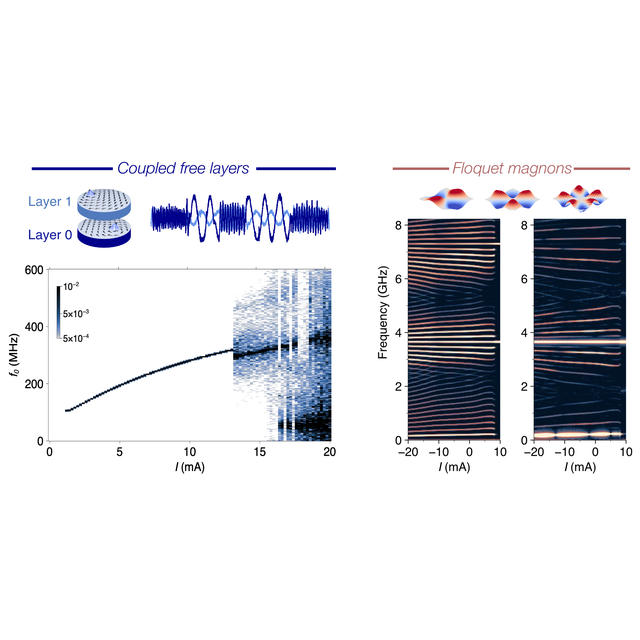
The first part of my thesis focuses on the dynamics in an STNO comprising two mutually coupled vortex free layers, where each layer serves as a dynamic polarizer for the other, increasing the number of degrees of freedom and therefore, the complexity of the system. For this study, I implemented the coupled Landau-Lifshitz-Gilbert equations including the mutual Slonczewski torque into Mumax3. This chapter highlights the role of asymmetry between the two free layers in generating complex dynamics, namely self-modulated oscillations, the emergence of C-state dynamics, as well as chaotic transitions between regular gyration and this C-state.
The two following parts are centered around the study of Floquet states in STVOs. Floquet states arise in periodically-driven systems and represent time-periodic solutions analogous to Bloch states in crystals. Recently, it has been shown that vortex gyration in thin-film disks can give rise to Floquet magnons. These states evolve from the scattering of linear eigenmodes with the core gyration, resulting in rich spectra featuring frequency combs with a strong dependence on the azimuthal number m.
This work inspired the second part of my thesis, in which I discuss Floquet modes in STVOs in which the background magnetization state is also nonuniform but possesses a lower symmetry than the vortex state. In particular, I focus on a rotating C-state magnetization, which can be likened to vortex gyration but with a virtual core outside the disk. I evidence that the rotation of such ground state leads to the recovery of cylindrical symmetry of the magnon eigenmodes due to time periodic modulation. These magnon eigenmodes form frequency combs similar to the ones of the vortex state.
The third and final part presents a reservoir computing scheme involving vortex Floquet states in the STVOs free layer. I show that by applying a current through our oscillator, one can damp or anti-damp the core gyration through spin-transfer torque, resulting in variation of the Floquet comb's spacing frequency and peak amplitude, which can then be exploited for reservoir computing in the reciprocal space. Using binary signals, I have performed short-term memory (STM) and parity check (PC) benchmarking tasks, showing promising results.
Jury members :
Amphithéâtre
10 boulevard Thomas Gobert
91120 Palaiseau