Séminaires
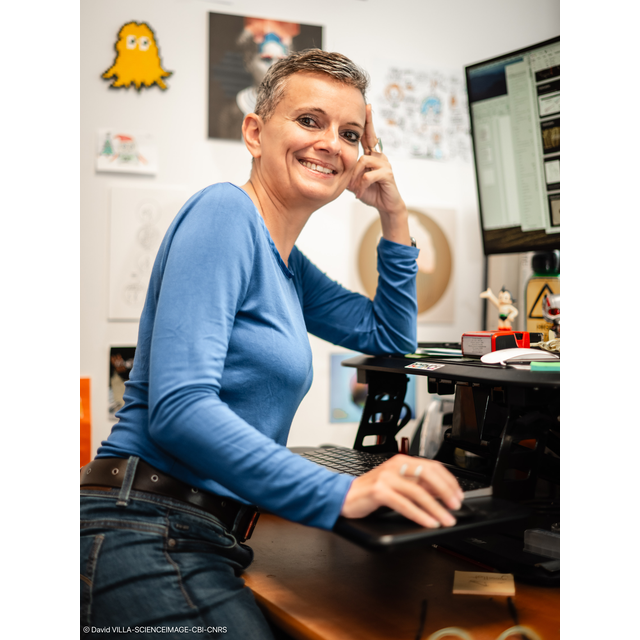
Le Blob : De la forêt à l'espace, l'incroyable parcours d'un organisme unicellulaire.
Centre de nanosciences et de nanotechnologies, Amphithéâtre, Palaiseau
Séminaires
La survie de toute espèce dépend de sa capacité à produire des comportements adaptés aux défis de son environnement. On a longtemps cru que cela exigeait un cerveau.Toutefois, les organismes unicellulaires, dépourvus de neurones, occupent des milieux complexes et y affrontent des décisions étonnamment proches de celles des animaux : trouver de la nourriture, s'adapter, éviter les prédateurs, dénicher les bons microclimats. Les myxomycètes se sont imposés comme des modèles puissants pour étudier la cognition basale, cette forme minimale de cognition qui émerge sans système nerveux. Dans cet exposé, je montrerai que Physarum polycephalum (le blob) présente l'ensemble des marqueurs de la cognition basale : il résout des labyrinthes, construit des réseaux efficaces, exploite l'information sociale, anticipe des événements périodiques, prend des décisions multicritères et se révèle capable d'apprentissage. J'en discuterai les mécanismes et les implications pour comprendre les origines évolutives profondes de la cognition. Enfin, je montrerai en quoi les blobs constituent un outil particulièrement accessible pour la médiation scientifique, en permettant des projets de sciences participatives à grande échelle qui rapprochent le public de la recherche et cultivent l'esprit critique.
Audrey Dussutour est Directrice de Recherche au CNRS, spécialisée dans l'étude du comportement animal, en particulier celui des fourmis, mais aussi du blob. Elle est l'auteure de plus de 70 articles scientifiques et de quatre ouvrages grand public : Tout ce que vous avez toujours voulu savoir sur le Blob, sans jamais oser le demander (Équateurs, 2017, Prix Science pour Tous 2018), L'Odyssée des fourmis (Grasset, 2022), Moi, le Blob (Humensciences, 2022, Prix Le Goût des Sciences 2023, Prix Science se livre 2023) et Les champignons de l'apocalypse (Grasset, 2025). Ses travaux sur les fourmis et le blob ont été récompensés par plusieurs prix, dont le Prix « Le Monde » de la recherche (2007), le Prix Wetrems de l'Académie des Sciences de Belgique (2011) et le Prix Fermat de l'Académie du Languedoc (2022). En 2023, elle a été élue membre associée de l'Académie Royale des Sciences de Belgique. Elle a coordonné deux grands projets de sciences participatives : Élève ton blob, proposé par le CNES en collaboration avec le CNRS et l'Académie de Toulouse, qui a réuni plus de 5 000 établissements scolaires et 350 000 élèves pour étudier l'effet de l'apesanteur sur le blob à bord de l'ISS, et Derrière le blob, la recherche, porté par le CNRS, qui a rassemblé plus de 15 000 volontaires pour étudier l'impact du réchauffement climatique sur la survie et la croissance du blob. Elle a été marraine des aires éducatives regroupant plus de 1 000 établissements scolaires de 2022 à 2025. Ses nombreuses activités de médiation scientifique ont été distinguées par la première médaille de médiation du CNRS en 2021, l'Ordre national du Mérite en 2022 et la Légion d'honneur en 2026.

(en anglais) Flickering and failed superconductivity in rhombohedral graphene
Centre de nanosciences et de nanotechnologies, Amphithéâtre, Palaiseau
Séminaires
Matthew Yankowitz is an Associate Professor of Physics and Materials Science & Engineering at the University of Washington. His research in experimental condensed matter physics focuses on the investigation and control of strong correlations, magnetism, superconductivity, and topology in two-dimensional van der Waals heterostructures, probed using a combination of electrical transport and scanning tunneling microscopy. Prior to joining the University of Washington, he was a postdoctoral researcher at Columbia University and received his Ph.D. in Physics from the University of Arizona. He is the recipient of an Army Research Office (ARO) Young Investigator Award (2020), an NSF CAREER Award (2021), the Lee Osheroff Richardson Science Prize from Oxford Instruments (2021), the IUPAP Young Scientist Prize in Low Temperature Physics (2022), and an ARO Early Career Program Award (2024). In 2026 he was named a Moore Foundation Experimental Physics Investigator.
Flickering and failed superconductivity in rhombohedral graphene
When a superconductor is cooled below its critical temperature, its resistance ordinarily falls to zero and stays there. I will present transport experiments on ultra-clean rhombohedral graphene that break this expectation in two ways. In parts of its gate-tuned superconducting phase diagram, we find that the resistance ‘flickers’ randomly in time between zero and its full normal-state value, with large regions of the sample switching together and remaining in each state for minutes at a time. The switching reflects a competition between two nearly degenerate electronic states, only one of which is superconducting. In another region of gate space, superconductivity instead appears to ‘fail’: the usual hallmarks of its onset are present, but the resistance saturates at a finite value, the signature of the long-debated anomalous metal. This state sits directly beside a zero-resistance superconductor in the same device, allowing the two regimes to be compared by gate tuning alone. I will discuss what these two behaviors reveal about superconductivity in a system with competing magnetic phases.
(en anglais) PhD Seminar C2N - 23rd october
Centre de nanosciences et de nanotechnologies, Amphithéâtre, Palaiseau
Séminaires
"Spin and orbital current conversion using topological insulator Bi1-xSbx alloy" by Mudit Jain.
Officient conversion of spin and orbital angular momentum currents into charge currents is central to advancing spintronic and orbitronic memory and logic technologies. Conventional ferromagnet/heavy-metal heterostructures rely on the spin Hall and inverse spin Hall effects, whereas topological insulators (TIs) such as Bi₁₋ₓSbₓ offer an alternative route with potentially superior spin- and orbital-to-charge conversion (SOCC) due to their spin–momentum–locked surface states. In BiSb, strong spin–orbit coupling gives rise to both spin and orbital textures at the surface, enabling the generation of both spin and possibly orbital angular momentum currents. However, these topological surface states are highly sensitive to magnetic proximity effects from adjacent ferromagnets (FMs), and disentangling spin versus orbital channels is complicated by interfacial hybridization, exchange coupling, and bulk contributions.
In this work, we investigate Bi₁₋ₓSbₓ/FM heterostructures using two complementary probes: terahertz time-domain spectroscopy (THz-TDS) emission, which detects ultrafast charge currents generated by femtosecond laser excitation (spin-to-charge conversion), and 2nd harmonic hall voltage technique to look into charge-to-spin conversion. And we grow these magnetic heterostructures using MBE and Sputtering.
"Topology-Driven Quantum Interference in Multi-Bridged π-Conjugated Molecular Junctions for Thermoelectric Applications" by Melih Aktas.
One dimensional topological π-conjugated materials, such as single-bridged polyacene polymers [1-3], can show electronic topological states without the need of spin-orbit interactions. These systems can be described with the Su-Schrieffer-Heeger (SSH) model and exhibit exceptional molecular transport properties via quantum interference (QI) effects between their topological edge states [4].
While single-bridge polyacene polymers have been widely studied, the impact of the number of connections between monomers on transport properties is missing. More precisely, double-bridged polyacene polymers can be described with a double-stacked SSH model [5] and effectively host twice as much topological states with respect to the single-bridged configurations. Therefore, investigating these stacked topological structures as molecular junctions (MJs) can reveal novel topological transport effects.
In this work, using state of the art ab initio techniques and non-equilibrium Green's function calculations, we studied coherent molecular electronic transport and linear-response thermoelectric properties of both single- and double-bridged polyacene MJs. Our results revealed that, in contrast with single-bridged systems, the QI between the frontier topological states of double-bridged polyacene MJs can intrinsically generate a Fano resonance in the electronic transmission spectrum, without the need of an interfering pendant group. This Fano resonance can strongly increase the thermoelectric figure of merit ZT. Furthermore, in both systems, we also observed that the sign of the Seebeck coefficient can be reversed with a topological phase transition.
Our work demonstrates an alternative way to generate Fano resonances in the absence of a pendant group in π-conjugated organic materials by modulating the topological phase of stacked-SSH-type organic MJs, leading to enhanced thermoelectric properties via QI effects.
"A silicon-based multilayer integration platform for photonics" by Gervasio Adriano D’anzieri.
The increasing complexity of photonic systems calls for integration platforms that can accommodate different functionalities while overcoming the limitations of single-layer architectures. This work presents a multilayer photonic integration platform combining the 220nm silicon-on-insulator (SOI) platform and silicon nitride, leveraging the properties of two well-established materials. By distributing photonic devices across two layers, the proposed approach enables a more flexible use of the available space and offers new opportunities for the integration of complex photonic functionalities.
A particularly promising application is the realization of optical phased arrays, where the integration of high-density antenna elements is a key challenge. In the proposed platform, the silicon nitride layer is dedicated to the implementation of a dense antenna array, while the silicon layer accommodates the guiding structures. Engineered optical coupling and decoupling between the two layers enable these functionalities to coexist while addressing the trade-off between antenna density and light routing.
The work focuses on the design and optimization of fundamental photonic components, the development of an analytical model and the simulations to describe interlayer coupling and scattering, the fabrication steps and the characterization of this multi-layer platform . These activities establish the basis for assessing the potential of multilayer integration as a versatile approach to advanced photonic systems.
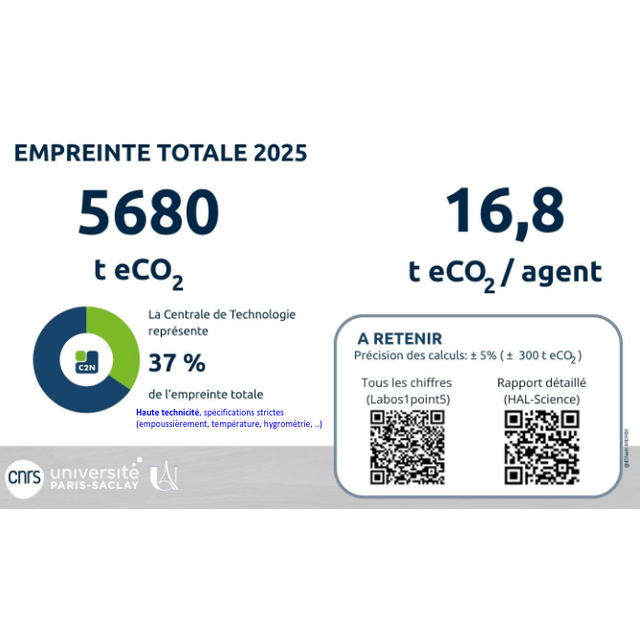
Restitution des résultats de l’enquête interne au labo. Bilan carbone : du calcul aux actions.
, C2N Amphitheater,
Séminaires
En pleine dynamique des semaines européennes du développement durable, la démarche du développement durable s'accélère au laboratoire et un temps de bilan collectif est proposé. Comme annoncé lors de l'AG du bilan carbone (données 2025) du 26 juin dernier, les résultats de l'enquête sur les actions carbone du C2N n'avaient pas pu être présentés. Une séance de rattrapage est ainsi organisée cet automne.
Au programme :
- Tirage au sort du grand gagnant du Quiz du développement durable !
- Restitution des résultats de l'enquête et présentation du bilan carbone.
- Temps d'échange et de discussion.
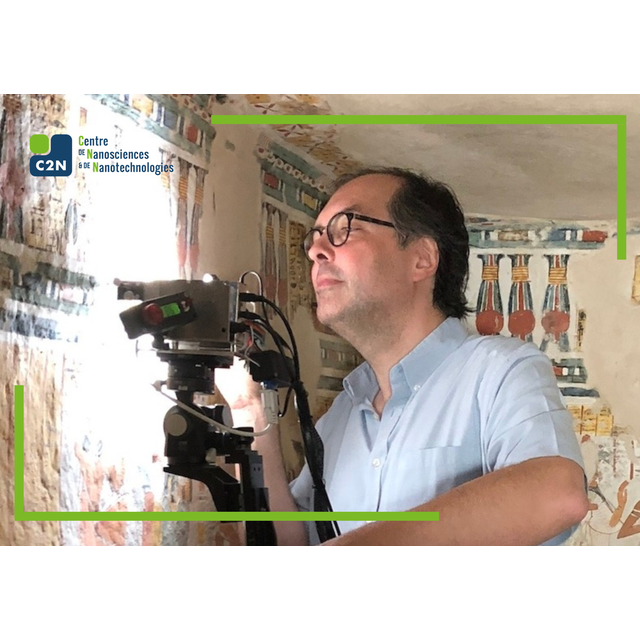
Combiner les méthodes d’imagerie chimique pour étudier les œuvres d’art
Centre de nanosciences et de nanotechnologies, Amphithéâtre, Palaiseau
Séminaires
Les analyses physico-chimiques des œuvres d’art permettent de mettre en évidence la complexité des techniques employées par les peintres pour réaliser leurs œuvres. Depuis les origines de l’art, l’artiste a dû en effet savoir choisir et transformer les matières qui étaient à sa disposition pour réaliser ses œuvres comme il le souhaitait. Si la recette employée n’était pas exacte, son travail risquait de disparaître rapidement. La chimie permet aujourd’hui de voir autrement notre Patrimoine. Les développements de méthodes analytiques et l’intérêt de leurs associations pour traiter de problèmes complexes seront illustrés par leurs applications dans des tombes égyptiennes et sur des tableaux de la Renaissance italienne.
Philippe Walter est membre de l’Académie des Sciences, directeur de recherche au CNRS au Laboratoire d'archéologie moléculaire et structurale à Sorbonne Université, qu’il a fondé en 2012, et vice-président de la Fondation de la Maison de la Chimie. Il est un spécialiste de chimie analytique, en particulier des méthodes d’analyse non invasives et mobiles. Il a ainsi développé des techniques innovantes mettant en œuvre des rayons X, des UV, la lumière visible et les infrarouges. Il applique ces méthodes à la caractérisation des matériaux du Patrimoine culturel et en particulier des matières picturales pour mieux comprendre leurs élaborations et les modifications qu’elles ont subies au cours du temps. Ses travaux aident à comprendre l'évolution des techniques artistiques au cours des siècles, et à mieux connaître ceux qui ont conçu et réalisé ces œuvres.
Participer à la réunion Zoom
https://universite-paris-saclay-fr.zoom.us/j/96360844937?pwd=5Zz7Zzuv3SCCV0yGbB626T1uBvNQ7K.1
ID de réunion: 963 6084 4937
Code secret: 453089
(en anglais) Dispersion-engineered structures for spatial control of electromagnetic fields
C2N, amphitheater, Palaiseau
Séminaires
This seminar presents a selection of research activities devoted to the spatial control of electromagnetic fields through dispersion engineering in structured media. Different physical platforms are considered, including mesoscopic photonic crystals, hybrid dielectric-plasmonic systems, and reconfigurable metasurfaces.
Examples include mesoscopic self-collimation and resonant cavities, wavelength-controlled plasmonic hotspots for sensing, optical tweezing and thermoplasmonic activation of VO₂, as well as guided-mode-resonance metagratings and graphene-based transparent surfaces for wavefront control.
The seminar aims to highlight the potential of dispersion engineering as a versatile tool for controlling the propagation, localization and interaction of electromagnetic fields across different physical platforms and frequency ranges.

(en anglais) Learning connection delays with backpropagation in spiking neural networks
Centre de nanosciences et de nanotechnologies, Amphithéâtre, Palaiseau
Séminaires
Spiking neural networks (SNNs) are appealing for AI because they are particularly energy-efficient when implemented on event-driven neuromorphic chips. Interest in them has surged recently due to a major breakthrough, known as surrogate gradient learning (SGL), which enables training SNNs via backpropagation, thereby solving real-world problems.
We recently demonstrated that SGL enables learning not only connection weights but also connection delays. These delays represent the time needed for a spike to travel from the emitting to the receiving neurons. Delays matter because they shift the spike arrival times, whose synchrony is often required to elicit an output spike. Learning these delays thus significantly enhances the expressivity of SNNs. Although this fact is well established theoretically, efficient algorithms for learning connection delays have been lacking. We proposed a family of delay-learning algorithms based on differentiable interpolation techniques that outperform previous proposals. Our results show that jointly learning weights and delays in fully connected, convolutional, and recurrent spiking layers substantially improves accuracy on several temporal vision and audio tasks, achieving new state-of-the-art performance.
Our approach is already highly relevant to the neuromorphic engineering community, as most existing digital neuromorphic chips (e.g., Intel Loihi, IBM True North, Spinnaker, SENECA) feature programmable delays, and many analog chips can also implement delays through their underlying circuit physics (e.g., BrainScaleS-2, DYNAP-SE2, DenRAM). In the long term, our research should also shed light on the role of myelin plasticity in the brain, which tunes conduction velocities and thus the delays.
Timothée Masquelier
Research Director - AI & Computational Neuroscience
(en anglais) Fully physical learning in oscillator networks
C2N - Centre de Nanosciences et de Nanotechnologies, , Palaiseau
Séminaires
Training neural networks is one of the defining computational problems of our time. This motivates the search for physical systems that can directly identify optimal model weights through the natural dynamical evolution of the system. Oscillator networks are an exciting platform for such physical computers, having demonstrated unique speed and energy advantages in tasks such as combinatorial optimization and time series classification. However, current progress towards training neural networks using oscillator-based systems have invariably relied on external control electronics that update system parameters following a learning rule. In my talk, I will present our recent efforts towards fully physical training in oscillator networks. To accomplish this, we co-locate weights and activations in a single physical system, using stable attractors to realize long-term memory for the weights, and short-lived degrees of freedom for the activations. Weight updates are implemented through the nonlinear dynamical evolution of the network, which realizes a local learning rule. I will discuss recent numerical results highlighting how relatively simple inter-modal interactions can give rise to emergent self-learning, and comment on our ongoing efforts to experimentally demonstrate physical training in a platform of MEMS oscillators.
Marc Serra-Garcia is a tenure-track group leader at the AMOLF institute on the physics of complex matter in Amsterdam, the Netherlands — A position he took after his studies at Caltech and ETH Zurich. His research focuses on developing elastic structures with novel functionalities by combining advanced design algorithms and precision microfabrication with insights from fundamental physics. His work includes the invention of a nonlinear system that extracts energy from random vibrations, the demonstration of wave-controlling materials based on topological insulators, and, currently, the development of elastic computing structures — from speech classifiers to entirely-mechanical microprocessors; area of research that has recently been recognised by an ERC Starting grant.