Ajouter à son agenda
 Kellian Cottart
Soutenance de thèse
Artificial intelligence is increasingly moving from data centers to edge devices, where neural networks must operate and learn continuously under severe constraints on memory, computation, and energy. At the same time, real-world environments are dynamic, requiring models to adapt to new information without overwriting what they have already learned. This thesis investigates a fundamental question for edge AI: can a neural network regulate its own plasticity and determine which information should be learned, retained, or forgotten?
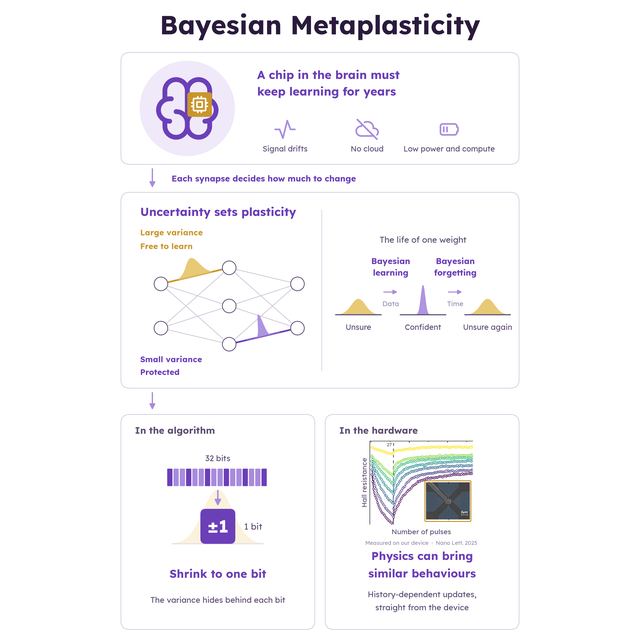
The thesis explores Bayesian metaplasticity as a general framework for addressing this challenge. It first introduces MESU, a Bayesian approach to continual learning in which each network parameter maintains an estimate of its uncertainty. By incorporating uncertainty into the learning dynamics and retaining a bounded memory of past information, MESU allows parameters to adapt their plasticity according to their confidence. This provides a principled balance between stability and adaptation without requiring explicit task boundaries or replay buffers.
The thesis then introduces BiMU, a binary Bayesian extension designed for resource-constrained computing. By combining one-bit parameters with uncertainty-driven plasticity, BiMU reduces the memory and computational requirements of continual learning while preserving uncertainty over long, non-stationary data streams. This uncertainty can also be exploited to identify the most informative samples and enable selective adaptation through active learning, further improving the efficiency of learning at the edge.
Finally, the thesis investigates how the same principle can be implemented at the hardware level through magneto-ionic synapses. The intrinsic electrochemical dynamics of these devices introduce history dependence and nonlinear update dynamics, providing a potential physical substrate for metaplasticity in which the synapse itself regulates the magnitude of its updates according to its internal state and history.
Overall, this thesis connects Bayesian inference, continual learning, low-precision neural networks, and neuromorphic hardware around a common principle: uncertainty can act as a mechanism for regulating plasticity. This perspective points toward edge AI systems whose synapses can autonomously determine when and how strongly they should adapt to their environment, enabling continuous and energy-efficient learning under severe hardware constraints.
Figure 1. Bayesian metaplasticity, from the problem to the device. A chip implanted in the brain must keep learning for years without the cloud and with almost no memory or energy, so each synapse has to decide by itself how much to change. The thesis lets a weight's uncertainty set its plasticity: a large variance (gold) leaves the weight free to learn, a small variance (purple) protects it, data narrows the distribution (Bayesian learning) and time widens it back (Bayesian forgetting). The principle is brought onto the chip in two ways: in the algorithm, weights shrink to one bit while their variance survives as a hidden confidence; in the hardware, a magneto-ionic memory cell shows history-dependent updates of its own.
Jury members:
Amphithéâtre
Centre de nanosciences et de nanotechnologies
10 bld Thomas Gobert
91120 Palaiseau