






Teams at C2N, working within an international collaboration, have developed Co/Pt multilayers combining magnetism and ultra-high-frequency acoustic vibrations — paving the way for future magnetoacoustic and quantum technologies.
Scientists in France and Argentina have demonstrated that cobalt–platinum (Co/Pt) superlattices, known for their robust magnetic properties, can sustain sound vibrations close to the terahertz frequency range, nearly a trillion times per second. Their findings open a new route toward integrating sound, magnetism, and ultrafast dynamics in nanoscale devices.
Acoustic vibrations at gigahertz to terahertz frequencies—known as hypersound—play a central role in nanoscale control of energy, heat, and spin. Yet achieving such vibrations in magnetic materials has been a long-standing challenge. The new study, published in Journal of Physics D: Applied Physics (2025), shows that metallic Co/Pt multilayers does not only exhibit perpendicular magnetic anisotropy, but also supports hypersound up to 900 GHz, key property for next-generation spintronic and magnetoacoustic systems.
The research was carried out through a collaboration between the Centre de Nanosciences et de Nanotechnologies – C2N (CNRS, Université Paris-Saclay, France) and the Instituto de Nanociencia y Nanotecnología (CNEA-CONICET, Argentina), led by Dr. Daniel Lanzillotti-Kimura and Dr. Mara Granada. “We show that Co/Pt superlattices are not interesting only for their magnetic properties, and acoustic resonators,” says first author E.R. Cardozo de Oliveira. “This dual functionality makes them ideal building blocks for manipulating magnetization using sound.”
The researchers grew the superlattices by magnetron sputtering and characterized their structure with X-ray reflectometry and electron microscopy, revealing highly periodic metallic layers. Magneto-optic and SQUID magnetometry confirmed strong out-of-plane magnetic orientation that increases with cobalt thickness. To investigate their acoustic behavior, the researchers used ultrafast pump–probe spectroscopy experiments, where femtosecond light pulses generate and detect sound waves within the nanoscale layers. The Co/Pt stacks produced coherent acoustic echoes up to 250 GHz and short-lived phonon modes reaching 900 GHz—among the highest frequencies ever observed in ferromagnetic systems. “These structures act as nanoscale acoustic resonators,” explains Dr. Lanzillotti-Kimura. “They provide a platform where hypersound could potentially interact with magnetic excitations, enabling new ways to control magnetism.”
Beyond fundamental physics, these results have direct implications for magnon–phonon coupling, nanoscale thermal management, and quantum information technologies. By engineering metallic superlattices with tailored thickness and interface quality, researchers can now tune both their magnetic and acoustic responses with precision. “This is a foundational step toward hybrid integration of ultrahigh-frequency acoustic phonons and magnons for magnophononic applications,” adds Dr. Granada. “Ferromagnetic superlattices like Co/Pt offer an exciting solid-state platform for future quantum and nanophononic technologies.”
Structural and nanoacoustic characterization of Co/Pt ferromagnetic superlattices
Journal of Physics D : Applied Physics
J. Phys. D: Appl. Phys. 58 (2025) 455301 (10pp)
https://doi.org/10.1088/1361-6463/ae148a
E R Cardozo de Oliveira1, C Xiang1, C Borrazás2, S Sandeep1, J E Gómez3, M Vasquez Mansilla3, N Findling1, L Largeau1, N D Lanzillotti-Kimura1
and M Granada3,4,
1Université Paris-Saclay, C.N.R.S., Centre de Nanosciences et de Nanotechnologies (C2N), 10 Boulevard Thomas Gobert, 91120 Palaiseau, France
2Universidad de Buenos Aires, Facultad de Ciencias Exactas y Naturales, Departamento de Física,1428 Buenos Aires, Argentina
3Instituto de Nanociencia y Nanotecnología CNEA-CONICET. Departamento de Magnetismo y Materiales Magnéticos, Gerencia de Física, Centro Atómico Bariloche, CNEA. Av. E. Bustillo 9500, R8402AGP San Carlos de Bariloche, Río Negro, Argentina
4Instituto Balseiro, Universidad Nacional de Cuyo-CNEA, Av. E. Bustillo 9500, San Carlos de Bariloche, Río Negro, R8402AGP, Argentina
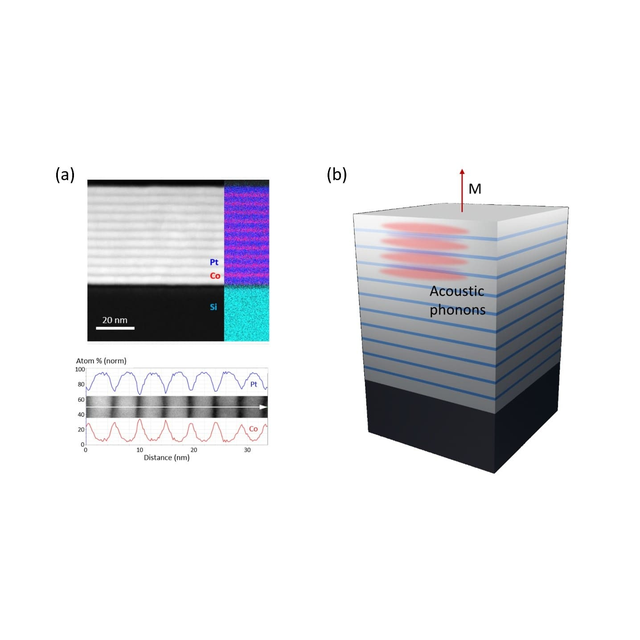
Figure : (a) Microscopy images reveal the layered Co/Pt superlattice, with platinum and cobalt clearly separated, on a silicon substrate. The composition map and profile confirm the regular stacking of both elements. (b) Schematic representation of sub-THz acoustic phonons and perpendicular magnetic anisotropy in the superlattice.