







Study in Science shows how tiny magnetic structures can generate exotic quantum-like states on their own.
Physicists at the Centre for Nanoscience and Nanotechnology (C2N), working with European collaborators, have discovered a surprising new way to control magnetism at the nanoscale. In a study published in Science, the team shows that microscopic “magnetic whirlpools” can create entirely new states of motion by using their own internal dynamics when triggered by external control signals.
The discovery sheds light on how matter behaves far from equilibrium and could help advance future technologies based on spin waves, a promising alternative to conventional electronics.
When Magnetism Sets Its Own Beat
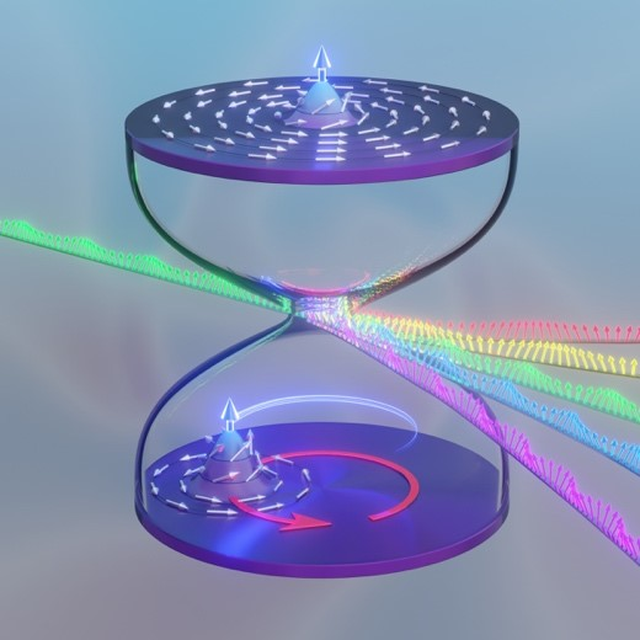
Inside many magnetic materials, spins—the tiny magnetic moments of electrons—can arrange themselves into a vortex-like pattern, similar to a whirlpool. At the centre of this magnetic vortex sits a small core that can move in a circular path, like a spinning top.
The researchers found that when this core moves rhythmically, it acts like an internal metronome, reshaping how energy flows through the material. This process gives rise to new, repeating energy patterns known as Floquet states, which normally require a very strong, precisely timed signal like a laser pulse.
“What’s remarkable is that the system only needs a weak signal from the outside,” said Joo-Von Kim, CNRS Research Director in the Novel Magnetic Devices (NOMADE) group at the C2N. “The magnetic structure then creates its own rhythm and reorganises itself in response.”
From Spin Waves to New Energy Patterns
Magnetic materials also support fast-moving waves called magnons, which carry energy and information through the collective motion of spins. In the experiments, the team observed that the moving vortex core reorganizes these spin waves into evenly spaced energy levels—forming a distinctive “frequency comb” that signals the presence of Floquet states.
Even more striking, the researchers showed that this process can happen in reverse: by strongly exciting magnons, the vortex core can be set into motion automatically. Once the core starts moving, it feeds back into the system and reshapes the spin-wave spectrum on its own. This self-starting feedback loop is what the scientists call self-induced Floquet engineering.
Why It Matters
Floquet states are of great interest because they allow scientists to create properties that do not exist in materials at rest. Until now, realising such states in magnetic systems has been challenging, often requiring intense laser pulses that can cause heating and instability.
By contrast, the newly discovered mechanism relies on internal motion already present in the material, making it more stable and energy-efficient.
“Magnetic systems turn out to be an ideal playground for studying complex, time-dependent behaviour,” said Thibaut Devolder, CNRS Research Director and head of the NOMADE group at the C2N. “This opens new opportunities for controlling magnetism in ways we couldn’t access before.”
Looking Ahead
The researchers believe that similar self-driven effects could occur in other magnetic structures, such as domain walls or skyrmions, and possibly even in superconducting or ferroelectric systems. In the long term, this work could contribute to the development of low-power technologies that process information using spin waves rather than electric currents.
References
Self-induced Floquet magnons in magnetic vortices
Science, 8 Jan 2026, Vol 391, Issue 6781 pp. 190-194
DOI: 10.1126/science.adq9891
Christopher Heins1,2, Lukas Körber1,2,3, Joo-Von Kim4, Thibaut Devolder4, Johan H. Mentink3, Attila Kákay1, Jürgen Fassbender1,2, Katrin Schultheiss1, and Helmut Schultheiss1
Affiliations
1Institut für Ionenstrahlphysik und Materialforschung, Helmholtz-Zentrum Dresden–Rossendorf, Dresden, Germany.
2Fakultät Physik, Technische Universität Dresden, Dresden, Germany.
3Institute for Molecules and Materials, Radboud University, Nijmegen, Netherlands.
4Centre de Nanosciences et de Nanotechnologies, CNRS, Université Paris-Saclay, Palaiseau, France.