







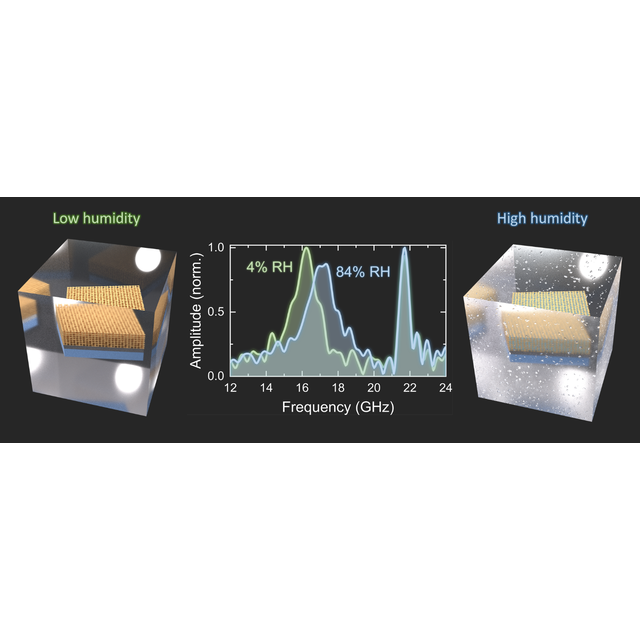
What if humidity could act as a control knob for hypersound ? Researchers have shown that nanometer-scale pores in thin films can “sense” moisture in the air and dynamically change how they trap sound, turning ordinary water vapor into a tool for controlling vibrations at the nanoscale.
Nanophononic devices — structures that control sound at the nanoscale — are emerging as key components for ultrafast signal processing, telecommunications, and quantum technologies. Tiny waves vibrating billions of times per second — far beyond what the human ear or even medical ultrasounds can detect — influence how light and electronic charges behave in materials. Until now, however, most nanophononic devices were static: once fabricated, their acoustic properties were fixed. This new work breaks that rule.
In a study published in Nano Letters, a collaboration between the Centre de Nanosciences et de Nanotechnologies (C2N-CNRS) and Sorbonne Université in France, and the Universidad Nacional de San Martín (UNSAM) in Argentina demonstrates a new class of nanoacoustic devices capable of sensing their environment and adapting in real time. Led by Dr. Daniel Lanzillotti-Kimura (C2N-CNRS) and Dr. Galo Soler-Illia (UNSAM-CONICET) and as part of the international CNRS IRP-PHENOMENAS project, the team engineered thin films of mesoporous silica—materials featuring highly ordered nanopores—whose acoustic resonances shift with humidity. “By exposing the nanopores directly to the environment, we created a platform where acoustic resonances respond to external conditions,” explains Dr. Edson R. Cardozo de Oliveira, corresponding author of the study. “This establishes a simple route toward adaptive nanophononic devices.”
Because the pores are only a few nanometers wide, even a small number of water molecules are enough to alter the material’s elastic and optical properties. As humidity in the air rises and water fills the pores, the frequency of trapped hypersound waves shifts, much like tightening a guitar string changes its note. The team observed tuning of nearly one gigahertz, a huge effect at these scales. “We are essentially teaching materials to listen to their environment,” explains Dr. Cardozo de Oliveira. “The nanopores act like microscopic ears that respond to what’s in the air.”
Using ultrafast laser techniques, the researchers tracked acoustic vibrations between 10 and 30 gigahertz and showed that frequency shifts directly follow changes in ambient humidity. In this process, water replaces air inside the pores, modifying stiffness and phonon propagation. “The nanopores act as active elements,” notes Dr. Lanzillotti-Kimura. “They translate environmental changes into acoustic signals that we can detect and control.”
This work introduces materials that do more than confine sound — they respond to the world around them. Potential applications include adaptive nanoacoustic filters and smart platforms for photonic and quantum technologies where precise vibration control is essential. “This work demonstrates that hypersound devices can be externally reconfigurable,” adds Dr. Soler-Illia. “It brings us closer to smart materials that adapt their acoustic response to the surrounding environment.”
By combining low-cost mesoporous fabrication with nanoscale acoustic control, the researchers establish a versatile framework for responsive nanophononics — a field where smart materials not only guide sound, but listen to their environment.
Références
Towards environmentally responsive hypersound materials
Edson. R. Cardozo de Oliveira1, Gaston Grosman2, Chushuang Xiang1, Michael Zuarez-Chamba2, Priscila Vensaus2, Abdelmounaim Harouri1, Cedric Boissiere3, Galo. J. A. A. Soler-Illia2, Norberto Daniel Lanzillotti-Kimura1
Nano Letters, Vol 26/Issue 3
https://doi.org/10.1021/acs.nanolett.5c05051
Affiliations
1 Université Paris-Saclay, C.N.R.S., Centre de Nanosciences et de Nanotechnologies (C2N), 10 Boulevard Thomas Gobert, 91120
Palaiseau, France
2 Instituto de Nanosistemas, Escuela de Bio y Nanotecnologías, Universidad Nacional de San Martín-CONICET, Buenos Aires,
Argentina
3 Laboratoire de Chimie de la Matière Condensée, Université Pierre et Marie Curie, 4 Place Jussieu, 75252 Paris, Cedex 5, France
Figure : Environmentally responsive mesoporous materials. At low humidity (left), the mesoporous thin film supports a specific hypersound resonance. As humidity rises (right), water fills the nanopores, altering the material’s stiffness and shifting the resonance frequency. The central graph shows this effect: increasing relative humidity from 4% to 84% shifts the acoustic modes by nearly one gigahertz, demonstrating how environmental moisture can dynamically tune hypersound in adaptive nanophononic devices.