







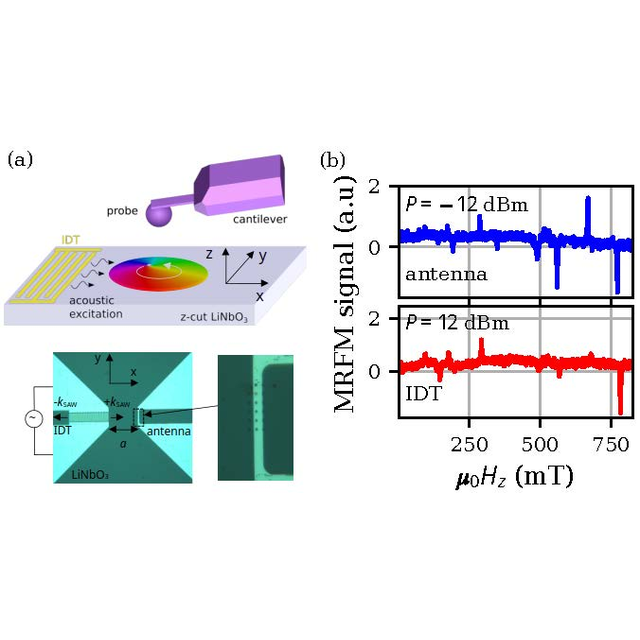
Most traditional applications of nanomagnetism rely on the coupling of magnetization with electromagnetic fields, either in the form of a slowly varying magnetic field for sensor-type applications, or in the form of microwave photons for information storage and manipulation. Magnetization also couples with the electron bath and with the phonon bath. The latter interaction has so far been scarcely exploited. Indeed, only a fraction of magnetic materials exhibit significant “magnetostriction” (direct coupling between the crystal lattice and the orientation of magnetization via spin-orbit coupling), and most of these magnetostrictive materials are not suitable for energetically efficient manipulation of their magnetization.
It has recently been demonstrated that, since the dipolar field of magnets depends on their shape, any magnet whose surface is dynamically deformed should experience a torque on its magnetization. In collaboration with CEA SPEC in Saclay and within the framework of the ANR MAXSAW project, a team from C2N demonstrated the existence of this “magneto-rotation” coupling and showed its ability to efficiently excite the magnetization of a magnetic nanocylinder in the microwave regime using a surface acoustic wave. Provided the geometric shape is properly designed, this opens the way to coupling the surface magnetization of nearly any magnetic material with its elastic degrees of freedom.
Technical part
Magnetic force microscopy (MRFM) was used to study the dynamics of magnetic vortices in submicron CoFeB disks fabricated on a piezoelectric substrate, as illustrated below. This geometry stabilizes a magnetic vortex state characterized by in-plane magnetization curling around a nanometer-sized core where the magnetization points out of plane. Classically, the vortex core can be brought into resonance by applying microwave electromagnetic fields. Under such excitation, the core undergoes a gyration motion, orbiting around its equilibrium position at a resonance frequency typically in the 100 MHz–1 GHz range.
The gyration of the vortices was compared when excited inductively by microwave magnetic fields and acoustically via surface acoustic waves (SAWs) generated by suitable interdigitated transducers (IDTs). Based on the device geometry and modeling performed by the C2N team, it was demonstrated that the excitation mechanism via SAWs results solely from rotations of the crystal lattice at the surface of the magnetic material and its immediate vicinity. This generates an effective “rolling” magnetic field localized only at the vortex core. This contrasts with the magnetoelastic stresses generally assumed in similar experiments, which would perfectly cancel out in the chosen disk geometry. This magneto-rotation torque can also be tuned using a perpendicular magnetic field.
The results indicate that non-uniform spin textures, such as magnetic vortices, can be useful for studying magneto-rotation coupling. Beyond opening new perspectives for microwave magneto-acoustics based on surface acoustic waves (SAWs), these findings also suggest that other non-trivial textures, such as domain walls and skyrmions, could exhibit behaviors not accessible through conventional magnetoelastic constraints.
References
Experimental Observation of Vortex Gyration Excited by Surface Acoustic Waves,
R. Lopes Seeger,1, 2, ∗ F. Millo,1 G. Soares,2 J.-V. Kim,1 A. Solignac,2 G. de Loubens,2 and T. Devolder1
Phys. Rev. Lett. 134, 176704 (2025).
DOI:10.1103/PhysRevLett.134.176704
Affiliations
1Centre de Nanosciences et de Nanotechnologies, CNRS, Université Paris-Saclay, 91120 Palaiseau, France
2SPEC, CEA, CNRS, Université Paris-Saclay, 91191 Gif-sur-Yvette, France
Figure caption : (a) Sketch of the magnetic resonance force microscopy experiment to detect the vortex gyration induced by surface acoustic waves. An IDT excites SAWs on a piezoelectric substrate propagating towards a disk in the vortex state (the colors encode the in-plane magnetization orientation). The setup includes a top antenna for the benchmarking with inductive excitation/detection, shown in the optical image. The inset is an enlarged view of the antenna’s constriction with several CoFeB microdisks. (b) Spectroscopy of the magnetic excitations achievable either using traditional antenna (top panel) or using the rolling field of the SAW (bottom panel) at 0.86 GHz, versus applied field. Most modes that are excitable by magnetic fields appear to be also excitation by the magneto-rotation torques.