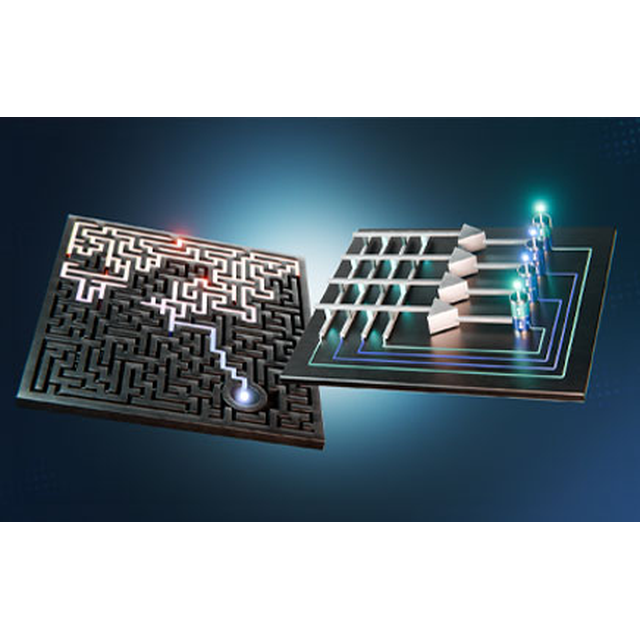







The mid-infrared spectral region holds growing importance for applications such as gas sensing and spectroscopy, and compact ultrashort pulse laser sources are essential to enable these applications. However, the fast gain dynamics of intersubband transitions hinders the direct generation of pulses from quantum cascade lasers (QCL).
In this work, based on a collaboration between C2N (CNRS/Universite Paris Saclay), ETH Zurich and Politecnico di Milano, we take advantage of the linear chirp of mid-infrared frequency modulated (FM) QCLs and the possibility to engineer group delay in passive photonic circuits to convert a quasi-continuous signal into ultrashort pulses in the mid-infrared, converting the source into an amplitude modulated (AM) comb. Our approach relies on chirped Bragg gratings implemented in Silicon Germanium graded-index photonic circuits for operation around 8 μm wavelength. With this approach, pulses as short as 1.39 ps were obtained. This establishes an FM- to-AM conversion strategy based on a passive photonic circuit that enables new approaches to integrated ultrafast pulse generation in the mid-infrared.
References :
On-chip pulse generation at 8 μm wavelength
[1] Annabelle Bricout,Mathieu Bertrand, Philipp Täschler, Barbara Schneider, Victor Turpaud, Stefano Calcaterra, Davide Impelluso, Afonso de Cerdeira Oliveira, David Bouville, Jean-René Coudevylle, Samson Edmond, Etienne Erth, Carlos Alonso-Ramos, Laurent Vivien, Jacopo Frigerio, Giovanni Isella, Jérôme Faist, and Delphine Marris-Morini,
Laser & Photonics Reviews, 2025; 0:e01485
https://doi.org/10.1002/lpor.202501485
Contact : Delphine Marris-Morini
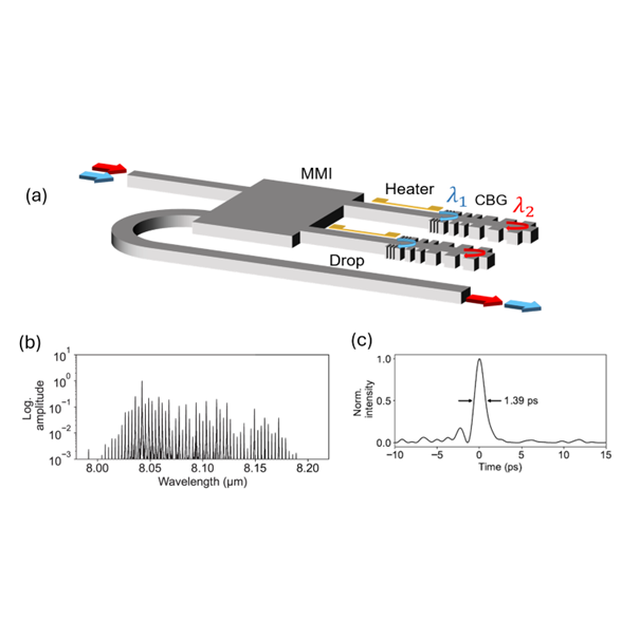
Figure: (a) Photonic integrated circuit for pulse formation: Initially, chirped light from frequency comb QCL is injected into a 2×2 MMI where it is evenly split between the two outputs. Each output contains a chirped Bragg grating reflecting and compensating the light chirp. The compensated reflected light re-enters the MMI and all light goes into a drop arm where the generated pulse is retrieved. (b) Amplitude spectrum after pulse generation with an emission band between 8 and 8.2 μm. (c) Extracted temporal intensity profile exhibiting a 1.39 ps wide pulse.
Funding. This work was partly supported by the French RENATECH network. This project has received funding from the European Union’s Horizon Europe research and innovation program (101128598 - UNISON) and from the European Research Council (101097569 - Electrophot).